

/ Featured Article
What are the different types of oil filters, and which one is best?
Did you ever stop to think about what kind of oil filter is on your motorcycle?


Your motorcycle's oil filter is likely one of those items you just replace indiscriminately every time you take your motorbike to the dealership or casa for preventive maintenance service (PMS). It's easy to dismiss the inner workings of an oil filter and simply believe what the manufacturer claims. As a result, we're frequently misled into thinking that the most expensive option is the best.
Now, if you watch a lot of motorcycle related content on the internet, apart of course from MotoDeal’s extensive selection of YouTube videos, you’re probably familiar with FortNine. Ryan has been producing high-quality motorbike videos for years and just published an exceptionally thorough video demonstrating how each type of filter works. Through a series of rigorous tests, the video also decides which type of filter is best. Continue reading after watching the video. You might be surprised by the outcome.
Paper filter
Paper filters are the most frequent type of oil filter found on OEM oil filters. They're inexpensive, simple to make, and can be found at almost every car and motorbike supply store. The modest paper filter came out on top in FortNine's tests. For starters, owing to its fibrous structure, which is made up of cellulose, cotton, wood fibers, and other absorbent materials. This implies it may remove water from your oil to keep your engine's innards from rusting. The paper filter had the best overall capacity and had a flow rate at 24 PSI.
An oil filter's duty, as you surely know, is to filter away crud, metal shavings, and particles while still allowing oil to reach your engine. The paper filter could handle the most metal shavings before it clogged—34 teaspoons of aluminum shavings. Finally, but certainly not least, effectiveness. The paper filter performed the best, reducing the ferrous metal index (FMI) of the used engine oil to 16, down from an initial measurement of 21, and a much lower 16 parts per million (PPM) of pollutants from an initial reading of 20.
Metal oil filters

Steel oil filters operate in the same way as your trusty old kitchen strainer does while you're making pancit canton. It permits liquids, such as oil, to flow freely while retaining heavier, gunkier particles like particulates and metal shavings—things you don't want near your engine's key components. As a result, you could assume that steel filters are superior to paper filters, but you'd be mistaken.
Sure, the steel filter provided the best flow at 22 PSI with the same pump power. Because of the improved oil flow, the engine should be less stressed. Steel filters are also incredibly durable, withstanding tremendous heat and pressure without breaking. The steel filter, however, was the first to get substantially saturated with metal shavings and clog, with just 9 teaspoons of particles before fully failing. Finally, the steel filter struggled to clean the old motor oil, lowering the FMI to 19 but allowing all 20 parts per million of particles to get through.
Fiberglass filters
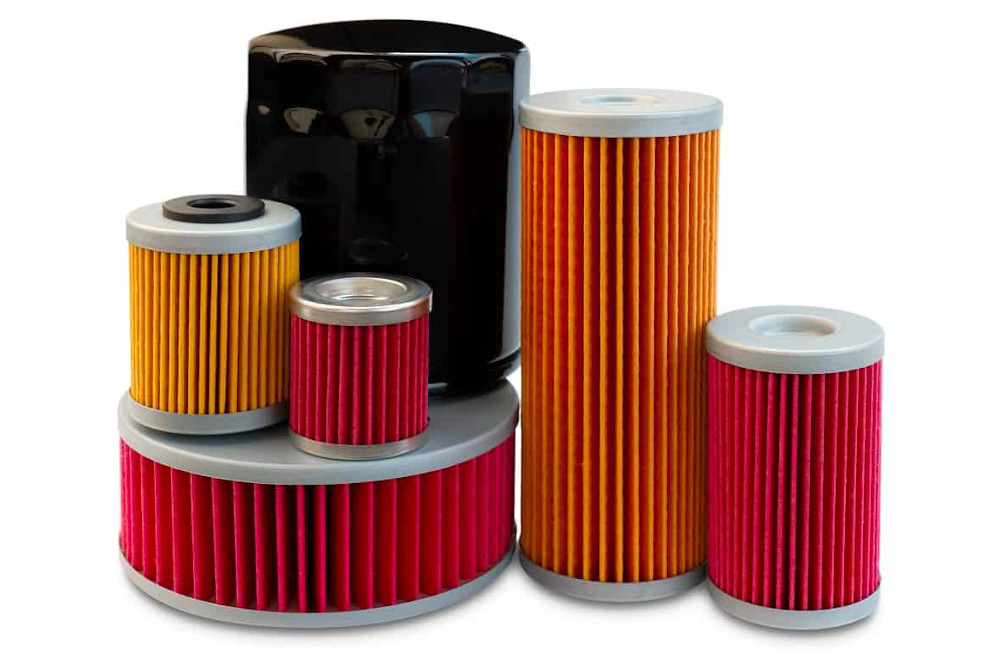
Fiberglass filters are frequently touted as having the best of both worlds: the effectiveness of a paper filter combined with the durability and smooth flow rate of a steel filter. The main filtering mechanism is fiber glass strands, which should theoretically be able to deliver the high flow rate of a steel filter combined with the decent absorption traits of a traditional paper filter. In theory , this makes sense since glass fibers are slippery and oil can easily pass through them. They are, nevertheless, excellent at trapping muck, detritus, and sludge because of their random strand matting. As a result, fiberglass filters tend to be the most expensive option.
The test results, however, show that fiberglass filters aren't all that wonderful. To begin with, at 25 PSI, the fiberglass filter had the most restricted oil flow. Second, although not clogging as quickly as the steel filter, it did so much faster than the paper filter, with just 14 teaspoons of particles. Finally, the fiberglass filter performed poorly, decreasing the FMI to 20 and the PPM to 18.
Related Articles
-

Last-minute Christmas gift ideas for your rider friends and family / Featured Article
Struggling to think of gift ideas for your motorcyclist friends and family? Read on to get some inspiration this gift-giving season.
-

Motorcycle 101: The inner workings of a slipper clutch / Featured Article
Slipper clutches are awesome as they make for more forgiving downshifts and a lighter clutch lever. Let’s take a closer look at them and see how they work.
-

5 things to remember when shopping for new motorcycle tires / Featured Article
Here are 5 things to consider when time comes for you to replace the tires on your motorcycle.
-

5 DIY maintenance jobs that can save you lots of money / Featured Article
Here are 5 do-it-yourself maintenance jobs that you can learn. Doing these maintenance items yourself not only help you learn more about your bike, but will help you save money in the proces...
-

These 3 signs tell you it's time for a new chain and sprocket / Featured Article
Never ignore these 3 warning signs that could mean that your bike needs a new chain and sprocket.
Latest Features
-
Last-minute Christmas gift ideas for your rider friends and family / Featured Article
Struggling to think of gift ideas for your motorcyclist friends and family? Read on to get some inspiration this gift-giving season.
-

Ride a naked sportbike? Get these 5 upgrades first / Featured Article
Here’s a quick list of 5 upgrades to your naked sportbike to enhance your riding experience.
-
Motorcycle 101: The inner workings of a slipper clutch / Featured Article
Slipper clutches are awesome as they make for more forgiving downshifts and a lighter clutch lever. Let’s take a closer look at them and see how they work.